Friday, February 12, 2010
Kaity summarizer

World Watcher
Pg.324
Impertinent-(adj.) intrusive or presumptuous, as persons or their actions; insolently rude; uncivil.
Sentence- The room was silent until the impertinent boy intruded the silence.
- Betty Smith used the word impertinent to show how someone can get into much trouble if impertinence was projected. During the time period, teachers were very strict and do not pardon impertinent acts from the students.
Contrite-(adj) filled with a sense of guilt and the desire for atonement; penitent.
Sentence- After Chris lost Hinda's priceless necklace, he apologized with contrite.
- The word contrite helps explain the tone of Francie when she realizes the burden her mother carries. It shows Francie's sincerity and her sympathy for her mother.
Thursday, February 11, 2010
Word Watcher
Pg.306
Grievous-(adj.) causing grief or great sorrow.
Sentence- The death of his mother was too grievous for him to handle.
Pg.313
Garnish-(verb.) to provide or supply with something ornamental; adorn; decorate.
Sentence- The wedding room was plain and dull, so he garnished it with lavish decorations.
Word Watcher
Pg.165
Poignancy-(noun.) intensity, emotion.
Sentence- The girl showed much poignancy when her team fought back to win the game.
Chapter 27
Pg.201
Surreptitious-(adj.) obtained, done, made, etc., by stealth; secret or unauthorized; clandestine.
Sentence- The boy was able to steal the toy by using his surreptitious mind.
- Betty Smith used the word surreptitious to show the way some people obtain the things they need. Hence, we can tell that during this time period, poverty forced people to treachery.
Pg.222
Haggard-(adj.) having a gaunt, wasted, or exhausted appearance, as from prolonged suffering, exertion, or anxiety; worn.
Sentence- She was a haggard, never willing to accomplish any work.
- Gussie was obsessed with his mother's breast milk, and by using the word haggard, it clarifies how much Gussie needs his breast milk.
Deprivation-dispossession; loss.
Sentence- The girl finally gets her toy after a long duration of deprivation.
- This word is used to show the frustration Gussie had after not having breast milk for so long. It seemed to be that Betty Smith made it seem like Gussie was a addict for breast milk.
Word Watcher
Pg.110
Impotence-(noun.) feebleness, helplessness, infirmity, powerlessness.
Sentence- The little girl was hopeless, she cried in her impotence.
- The word impotence show the frustration of Francie when she can't handle the fact that other kids are mocking her parents. This shows Francie expressing emotion, which she will do more further in the novel.
Grotesque-(adj.) odd or unnatural in shape, appearance, or character; fantastically ugly or absurd; bizarre.
Sentence- The boy is grotesque when he began to show his ugly side.
- Betty Smith uses the word grotesque in order to describe the way kids were back in the 1900s.
Chapter 19
Pg.152
Recalcitrant-(adj.) resisting authority or control; not obedient or compliant; refractory.
Sentence- The boys at school are recalcitrant, never obeying the regulations of the school.
Word Watcher
Pg.88
Beguile-(verb.) to take away from by cheating or deceiving.
Sentence- The smart man was able to beguile his stolen money back.
- Sissy was able to beguile the man into letting her open a charge account until Saturday payday. From this we can tell that during the early 1900s people were easier to bargain with and store owners will let you slip once in a while if you didn't have money. Betty Smith used this word to show how close the community was and how everyone lets people get away with things a couple of times.
Pg.101
Celibacy-(noun.) abstention from sexual relations.
Sentence- Fiona promised celibacy until marriage.
Chapter 13
Pg.109
Begat-(noun.) genealogical lists, esp. those in the Old Testament.
Sentence- I read the begat to my son before bed.
- The word begat can tell us that religion was very important in Francie's life and also a major culture during the 1900s.
Word Watcher
Pg.62
Limpid-(adj.) free from obscurity; lucid; clear.
Sentence- The teacher was great, she was very limpid and I had no trouble understanding her.
- By using the word limpid, we get a further description of Mary Rommely, Francie's grandmother. Betty Smith was able to describe Mary Rommely has a big impact in Francie's life because of the unique qualities Mary Rommely had.
Sentence- He is very intelligent and he is also very ambitious.
- We know that Evy, another Rommely girl, is very eager and always trying to accomplish something.
Pg.72
Sentimentality-(noun.) the state of being tender in emotions and feelings, as love, pity, or nostalgia.
Sentence- Joshua always shows sentimentality, when he misses his home the most.
- Betty Smith wrote that Francie had Johnny's sentimentality,and through this we know that Francie's family is full of unique people, who possess certain qualities that Francie also shares with.
Word Watcher
pg.5
Serene-(adj.) calm, peaceful, or tranquil; unruffled.
Sentence- Marty was a very serene person, always calm in difficult times.
- Betty Smith used the word serene in the beginning paragraphs to depict the environment of Brooklyn during the summer time of 1912. This word help Betty Smith establish the setting of this novel.
Ragamuffin-(noun.) a child in ragged, ill-fitting, dirty clothes.
sentence- These ragamuffins intrudes the eloquent party.
- The word ragamuffin was used in order to depict the demographic of Brooklyn at the time. Clearly there was a lot of poor civilians.
Pg.48
Pungent-(adj.) sharply affecting the organs of taste or smell, as if by a penetrating power; biting; acrid.
Sentence- The corpse laid there for over a week, and it began to have a pungent smell.
- The word pungent helps further explain the environment our protagonist faces in the novel. " It was still early in the evening and the street light had not yet come on. But already, the horseradish lady was sitting in front of the Hassler's grinding away at her pungent roots", this excerpt shows the way people acted during 1912 and unfortunately they don't act as civilized as we do today.
Researcher: About the Author
- Both were born in December of 1896.
- Both of them grew up in poor areas of Brooklyn.
- Both became writers.
- There is a photo of Betty on her fire escape in the book, similar to the one Francie used to read on.

Researcher: Education in the 1900s

In the book, it is important to Katie for her children to get an education. She was never taught how to read and write and she believed that being educated would help get her kids out of the slums. Francie and Neeley were very fortunate to get a chance to learn.
Schools and the Economy
Increasingly in the first decade of the twentieth century, the purpose of American schools was seen to be integrally related to the economic well-being of the nation, and school leaders became progressively more concerned with producing qualified workers for the nation's changing workplace. Indeed, during the period 1900 to 1909, there were some people, both inside and outside the educational establishment, who regarded as simply unproductive the act of encouraging students to acquire knowledge for its own intrinsic value. In fact, traditional educators, who sought to educate students for the purpose of, in the language of the day, "developing the faculties of the mind," appeared to many school reformers quaint and irrelevant. In the new social and economic climate, new subjects and new curricula were touted and implemented by modern school administrators who were eager to adapt public education to the new demands confronting it. By the middle of the decade, a coalition of conservative and liberal reformers, pushing for even stronger links between the national educational system and American business, introduced vocational education in the schools; and this strengthening school-business bond intensified to the end of the decade.
Immigration and Schools
By the beginning of the 1900s, foreign peoples were immigrating to the United States in unprecedented numbers, with a majority coming from countries and ethnic groups not widely represented in American society before this time. A majority came from countries and ethnic groups not previously represented in large numbers in American society. In the thirty-year period from 1890 to 1920, approximately 18.2 million newcomers entered the country. Because of this influx of immigrants, schools around the country—especially urban schools—were inundated by immigrant children seeking an education. In 1905 alone, some sixty thousand to seventy-five thousand such children were denied admission to New York City schools because these schools had no space for them. Meanwhile, to help immigrants and their children adjust to American society, educators in urban school systems created special courses to teach English and provide instruction in American political and civic values. In the decade 1900 to 1909, Americanization, the name used to describe this assimilation process, became the watchword for the nation's public schools.
Urbanization and Schools
In nineteenth-century America, rural district schools were governed by well-known community leaders whose decisions regarding hiring and the school curriculum generally reflected local values and local concerns; but in the first decade of the twentieth century the development of large urban school systems brought a dramatic change in school governance. Rapidly, large bureaucracies sprang up, and decision-making became the function of faceless and anonymous managers. These profound changes occurred in the name of expertise and efficiency and undoubtedly had some positive effects; but they greatly reduced the close ties that earlier had existed between schools and their communities. Now new, age-graded schools with lockstep curricula became the norm in nearly all urban areas. Within the educational system, order, regularity, and predictability were gained, but only at the expense of individuality and flexibility.
Citation:
Researcher: Chapters 12-14
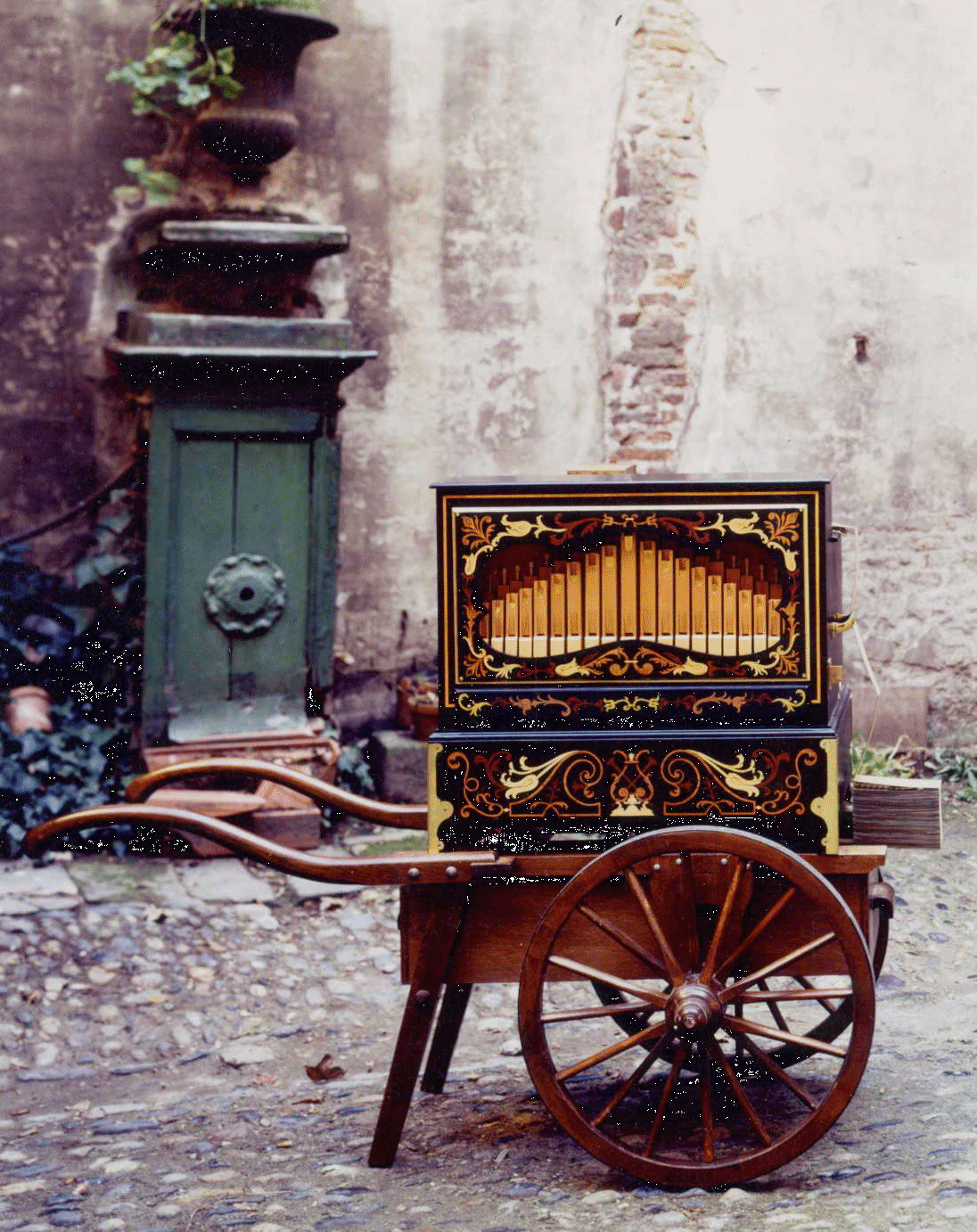
The street organ is played when the organ grinder cranks it and music plays. A White-headed Capuchin monkey was often brought along to do tricks and attract attention. The monkey would collect the money from the audience and sometimes collect other shiny objects that attracted his attention. Other attractions might be parrots, dogs, dancing bears and members of the organ grinder's family who would dance and singThey moved from place to place after collecting a few coins in order to avoid being arrested. The authorities often encouraged policemen to treat the grinders as beggars or public nuisances. Music lovers usually hated the organ grinders because most were tone deaf and lacking any sense of rythm. In New York City there were as many as 1500 organ grinders on the streets at a time - one on almost every block.
Researcher: Chapters 12-14
- red rover
- jump rope
- king of the mountain
- kick the can
- hide and go seek
- stickball
- marbles
- hopscotch
- jacks
Red Rover began in England in the 19th century before making its way over to the United States. There are two teams that stand in lines opposite each other. The players hold hands and form a chain. They then call out, "Red rover, red rover, send [name of player on the opposite team] over!" That player runs over and tries to break the chain of hands. If they do not succeed, they become a part of the opposite team. if they do succeed, they go back to their original team. When there is one player left on a team, they must try to break through the chain. If they succeed, they get another player and the game continues. If the do not, larger team wins.
Jump Rope is a game where one or more person jumps over a rope that is swung above their heads and below their feet. It can be played in a group or alone. Double-dutch is a method of skipping rope that involves two ropes.
King of the Mountain involves a hill or pile in which the players try to get to the top in order to be "King of the Mountain". When someone is alread king of the mountain, the other players try to knock them off so they can get to the top.
Kick the Can is similar to tag. One person or a team of people is designated as "it" and a can or similar object is placed in an open space. The other players run off and hide while "it" covers his or her eyes and counts to a previously decided number. "It" then tries to find and tag each of the players. Any player who is tagged (caught and touched) is sent to the holding pen (jail) which is simply a designated area for all the captured players to congregate, generally in plain sight of the can. Any player who has not been caught can "kick the can". If they can do this without being caught, then all of the captured players are set free. If "it" catches all of the players he or she wins that round and generally a new "it" is designated for the next round.
Hide & Seek is a game where one player is "it" and counts to a number while the other players hide. "It" must find the other players, the first one found is the next player to be "it". This game can be played with two or more players.
Stickball is the street version of baseball.The equipment consists of a broom handle and a rubber ball.This game was widely popular among Irish, Italian, Jewish, and Puerto Rican youths growing up from the 1920s to the 1980s in Boston, Philadelphia, New York City and Northern New Jersey. A rectangle is drawn on the artificial backstop in order to create a strike zone. The rectangle is chalked. If the batter does not swing and any part of the ball has chalk on it when it bounces back to the pitcher, the result is a called strike.
Marbles has many ways to be played. The most common version of the game involves drawing a circle in sand, and players will take turns knocking other players' marbles out of the circle with their own marble. This game is called ringer. Other versions involve shooting marbles at target marbles or into holes in the ground (such as rolly or rolley hole).
Hopscotch is played on a drawn court. There are many variations to drawing the court, but the course is usually composed of a series of linear squares interspersed with blocks of two lateral squares. The first player tosses the marker into the first square. The marker must land completely within the designated square and without touching a line or bouncing out. The player then hops through the course, skipping the square with the marker in it. Single squares must be hopped on one foot, and side by side squares are straddled. Upon successfully completing the sequence, the player continues the turn by tossing the marker into square number two, and repeating the pattern. If while hopping through the court in either direction the player steps on a line, misses a square, or loses balance, the turn ends. Players begin their turns where they last left off. The first player to complete one course for every numbered square on the court wins the game.
Jacks originated hundreds of years ago, when the only playthings boys and girls had were materials they found near their homes. After the players decide who goes first, then jacks are scattered loosely into the play area. The players take it in turn to bounce the ball off the ground, then pick up jacks, and then catch the ball before it bounces for a second time. The number of jacks to be picked up is pre-ordained and sequential: at first you must pick up one ("onesies"), next two ("twosies"), and so on like mentioned on page 112 of the book. Depending on the total number of jacks included, the number may not divide evenly and there may be jacks left over.
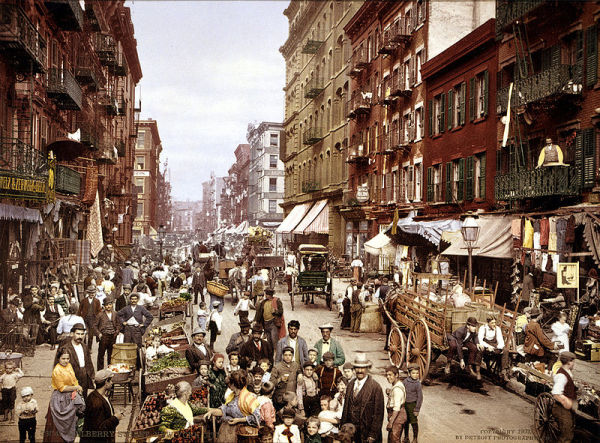
Researcher: Urban Poor Life
Researcher: Chapters 4-6
The Hebrew looked at the Irish child with his red-rimmed eyes, small, tortured, and fiery.
- Sheeny is an offensive term used towards Jews. It means whomever is called it is being called dishonest.
- Goyem (or Goyim) is a word used towards non-Jews. A person being called this is being called ignorant.
There was religious segregation between neighborhoods and harrassment between different religious groups in the early 1900s, especially between new immigrants and American citizens who had been in the US longer. As we learn in the book, Francie and her family have a hatred towards Jews. She is not friends with any and later on in the book it mentions they had have their home blessed before moving into it. Also, she has a friends only because they share a religion.
Researcher: Chapters 1-3
- A soprano is a singing voice with a high singing range from approximately middle C (C4) to "high A" (A5) in choral music, or to "soprano C" (C6, two octaves above middle C) or higher in operatic music.
- A tenor is a type of male singing voice and is the highest male voice within a modal register.
Wednesday, February 10, 2010
Chapters 52 - 55
- Has Francie seemed to recognize that people's perceptions of the world are often more powerful than the world itself? How so?
- Why is it that Francie does not want to revisit her past?

Jenna S.
Tuesday, February 9, 2010
Chapters 46-49
• Sissy is a character who greatly changes from beginning to end. As a young woman, she has many lovers and does not take her marriages seriously because they were not in the church. In Chapter 38, Francie notices that Sissy no longer wears perfume, and she no longer wishes to attract men. Even when Sissy accompanied Francie to her graduation, Francie noticed that she paid no attention to the man in uniform who the passed on the way. Now, Sissy's marriage in the church signals a complete change. Her husband feels assured she will never walk out on him, and the narrator says she is more in love than ever. In addition, she consents to calling him by name, a sign that she regards him individually, instead of one of many lovers, or "Johns." Sissy's feelings of regret about her past lovers also suggest a major change. Now, lovers are a mere memory and not a temptation.
- What caused this turning point for Sissy?
- Do you notice a turning point in other characters?
- How does Sissy's new character relate to modern women of today? Compare/Contrast?
Second Insight...
• Francie's jobs have given her a kind of education that she could never have received in school. Katie's eagerness to send her to college reaffirms her concern for her daughter's education; which therefore, shows a great responsibility. Although Katie has let Neeley go back to high school, she never sees this decision as replacing Francie's opportunity.
- Would this situation most likely occur presently? Why/Why not?
- How will this pre-exsting decision effect Francie's future? How will it differ her future from her siblings'?
Jenna S.
Chapters 37-40
- How would you feel, as Francie, taking on such large responsibility for the caring of her pregnant mother?
- Does this situation re-visit the "Coming of Age" theme? How so? How must it feel going to school, losing your father, and taking on such a large role at home; while still overflowing with emotions due to a family absence?
Chapter 40
• Francie takes care of Katie the days and hours before she goes into labor. The evening of the birth, Francie sends Neeley for Evy and tells tells her mama straightforwardly that Neeley would know better how to comfort her. Katie goes into a discussion about how men should not assist in births, that women always insist they stand beside them.
- Through your eyes, does this situation suggest a symbol of Francie's emtions towards missing her father? Possibly spoken out of anger?
Jenna S.
Monday, February 8, 2010
Insights and Questions
• Johnny's death is foreshadowed throughout the book. For example, in the beginning of the book, the narrator says that all the Nolan men die before they are 35. Many other details in the plot have prepared for this moment as well; Katie has thought many times that Johnny will not be with them for long. Francie's diary entries in Chapter 32 not only record a high frequency of sick days, but also detail Johnny's decline in health.
- What other hints of foreshadow can you recall regarding Johnny's death?
Also relating to corresponding chapters...
• The day that Johnny gets thrown out of the labor union; shall we consider this a turning point for the novel? It is a symbolic death, or "loss," that signals Johnny's real death? Without the labor union, Johnny has nothing, not even singing jobs, which at least gave him some sense that he was contributing to the welfare of his family. Johnny's reaction to the news is another sign that something has changed and nothing can be as it was before.
Chapters 37-39
• After her fathers death, Francie asserts that she no longer believes in God. Francie begins to puzzle over the big questions: if God brought Johnny into the world, did not that mean that God wanted him alive? Why is God punishing Johnny? Although Francie has questioned God's means before, she never says she doesn't believe in Him until her father dies.
- Does the theme of "Religion" play a role in the novel? How so?
- Through your eyes, should Francie separate from God, or pray in regards to her father? Is this situation caused by age/kids at school? (Influence by others.)
Jenna S.
Questions Relating to the Character of Johnny
- As Johnny is passionate and loving, he captures Francie's heart even if he isn't a model of the conventional good father. Why is it that Francie eliminates the anger in which she feels about her father, as his alcohol addiction truly does effect her and her siblings?
-Place yourself in Francie's shoes; would you confront your father about his addiction, or allow for the situation to cease?
• Johnny represents the "American dream," in a way. While Katie survives, Johnny's life of poverty only propels him into a downward road. He has a sense of who he could be, what he could have done, and this seems to be his toughest challenge. However, he often causes the family to lose money; his drinking results in their move, for instance. Although, the moral value system in the novel is produced through Johnny's character, as Johnny represents a character who no one will reform or moralize. Johnny's faults do not overpower his good qualities, and characters in the book do not try to save him, but instead, accept him as he is. (i.e Francie)
- Although Johnny is doing wrong for his family, why do they continue to have love for him? Why hasn't Katie spoken to him regarding his actions? Would this classify as a good example to prove that sometimes, the most admiring individual can still be one who is portrayed as harmful to others around him? (i.e Frank and his waste of money, effecting his family.)

Jenna S.
Sunday, February 7, 2010
Mid-Novel Questions
Chapter 32
• Francie had started a diary in December, on her thirteenth birthday. Now, nearly a year later, she is reading it; majority of the diary entries tell that Papa is "sick" again - Katie's way of saying that he is drunk.
- How has Johnny's alcohol addiction effected Francie?
- How does Francie see Johnny through her own eyes? Does she pity him for the money he has wasted on alcoholic beverages?
More involving the themes of Alcohol and Poverty
• Through my eyes, nearly every situation, character, and chapter represents or addresses the problem of poverty in early twentieth-century America. Being poor means that the characters constantly must think of being poor—how they will buy the next loaf of bread, or what one's house or neighborhood looks like compared to another.
- In which ways has poverty effected Francie and her family? Has Johnny significantly contributed to this issue?
• Although having money makes for an easier life, in many cases, the most lovable characters in the book are indeed victims of poverty.
- As Betty Smith implies this concept, which life moral is being translated to readers?
Jenna S.
Friday, February 5, 2010
Chapters 20-30
• Francie's schooling shows how she will live a life with more opportunities than her parents have had. Mary has great hope because her children can read and write, unlike herself.
• Johnny's interest in educating his children further develops the importance of knowledge through the eyes of Francie's parents; possibly, relating to time period. Despite the problems between the adults in this novel, they all agree that they want their children to be well-educated, and out of the slums. Johnny in this chapter is compared to Mary Rommely, who believes that her children will live a better life than she did because they can read and write. Clearly, chapter 26 states that not only will Francie learn to write, but that she will also grow up to be a writer.
- How will this future accomplishment allow Francie's stand in society to differ from her uneducated parents'?
- Is the theme of "Education" evolving into the novel?
Chapter 28
• As Francie grows up, she comes to realize the ugly side of poverty; as she becomes more of a realist. Her thoughts about the theater show that she is thinking just like her mother; she thinks the heroine should marry the villain to "solve the rent problem" for instance, and she knows that if the heroine lost her job, she would easily find other low-wage work.
- How will this mindset effect Francie's future? Positively/negatively? Is this the overpowering effects of reality?
Jenna S.
Monday, February 1, 2010
Beginning Thoughts/Questions
- How can the symbol of this tree, relate to Francie's life? What do both the tree and Francie have in common?
• The first few chapters establish the importance of setting in this novel; moreover, in just the first chapter, the narrator describes the entire Brooklyn neighborhood through Francie's eyes on a typical Saturday afternoon. This includes many of the neighborhood personalities, people, and places: Carney and his junk shop, Cheap Charlie's, and all the different food stores.
- Can the literary element of setting given to us, as the readers, during these first few chapters possibly set the definition of Francies character; where she has came from, and how she views society around her? Could this setting establish the theme of "Growing Up" or "Coming of Age?"
• Flossie and Henry Gaddis represent both love for life and fear of death for Francie. Francie takes great joy in small items, such as Flossie's dresses.
- How may Flossie and Henry Gaddis represent a role model through the eyes of Francie? Can this relate to similar childhood experiences?
• The neighborhood stores where the children are sent for food reassure us, as the readers, that the Nolans live in an underprivileged immigrant community. Furthermore, in this time and place, the ethnic groups remained segregated. Francie most likely does not know when she insults the pickle man because she has no Jewish friends. Maudie and Francie are friends partly because of their common Catholic heritage.
- As established by surrounding setting, Francie clearly experienced the views of segregation and had to obey all corresponding rules; how might this concept effect Francie's character? In the future? (Relating to Chapter 4, where she is unaware of when she insults the pickle man because she has no Jewish friends.)

Jenna S.
Friday, January 22, 2010
Welcome, Everyone!
Roles:
• Danielle: Researcher
• Alex: Word Wizard
• Mary: Literacy luminary
• Jenna: Questioner
• Kaitlyn: Summarizer
Schedule:
• Read three chapters per night; start date: January 22nd, end date: February 10th.