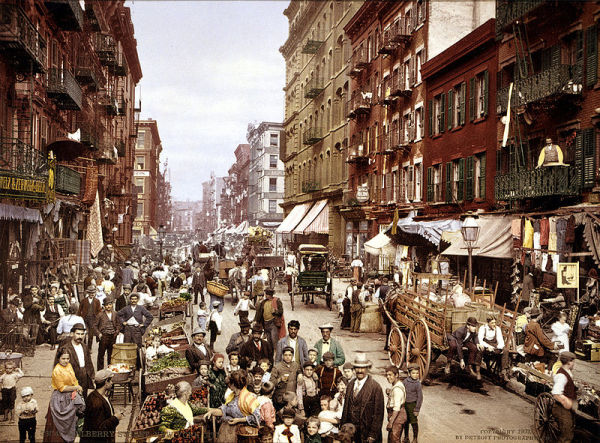
In urban areas in America in the early 1900s, many immigrants settled into slums. In the 1910's 33%-50% of the labor force lived in slums. In New York many lived in overpack apartment buildings, sometimes up to 2,500 people living on just one block. In the book, we notice that Francie's family does not have their own bathroom. They share it with the other families in their apartment building. The book also mentions that some apartments didn't even have bathrooms.
Tenement life for immigrants was worse. A tenement is an urban apartment building usually with over 3 floors. Jacob Riis wrote about these and once described a 14-square foot yard being used as a play area for 170 children.
The people living in these conditions were surrounded by disease. there was no heat in the winter and a lot of the time many families would be crammed into the same apartment.
"A wife spent a great deal of time running up and down the stairs - tenement houses generally had five floors, with the cheapest apartments on the top. Even if the building provided water and a hall toilet, she had to make several trips to the basement each day for coal. Few apartments had much in the way of refrigeration, so every meal required a run to the store for fresh food. Checking on children, throwing out dirty water, delivering piecework to the contractor - the women, who were frequently pregnant, spent their lives climbing. Cleaning was a constant battle, given the city soot and the number of people using every inch of a tenement apartment."
-America's Women by Gail Collins
There was often little money in the families. People starved and died.Many immigrant women, for instance, were so under-nourished they could not nurse their children. In many situations, families had to resort to child labor to have enough money to get by.

This detailed research truly gave me a sense of the setting taking place in our novel. It is truly hard to place myself into Francie's shoes, not having a bathroom in my own home. Your information about tenements gave me another insight regarding life conditions of the urban poor life; through my eyes, it seems that living in a tenement is the worst possible condition one can find themselves in. Based on your research, not only are tenements small and unsanitary, however, more than one family were crowded into one apartment, which caused a large spread of disease. I also now understand the home-confining roles of women during this era. Does anyone believe that the setting of this novel effects certain developing themes?
ReplyDelete